Unfortunately, we don't support Internet Explorer anymore as it has been replaced by Microsoft Edge.
Please try downloading Microsoft Edge or an alternative modern browser for the best experience.
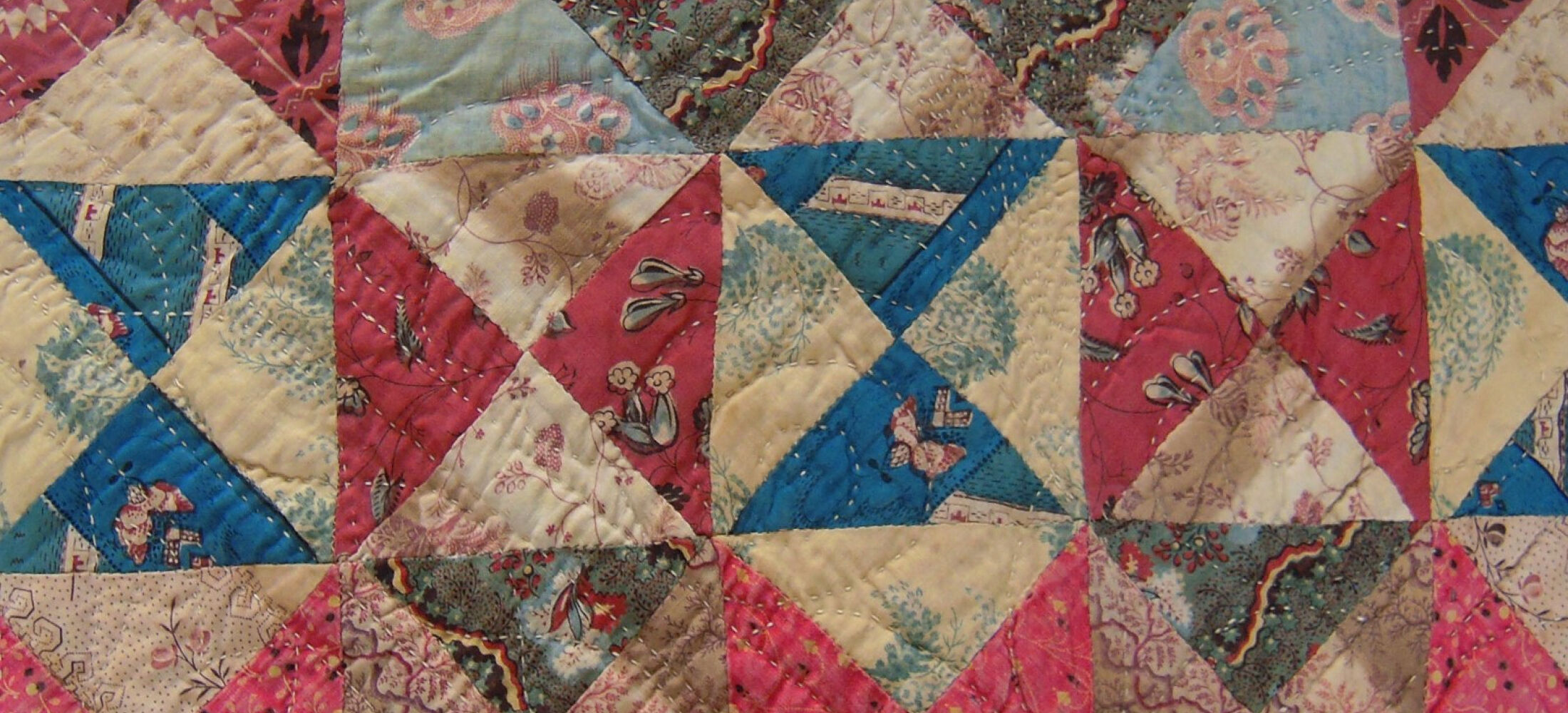
This hand-stitched piece of patchwork was made around 1820 - 1830. Although it has no provenance, it has clearly been designed for a chair seat, measuring 18” (45 cm) in depth and increasing in width from 17” (44 cm) wide at the back to 23” (59 cm) wide at the front.
From the Collection of Carolyn Gibbs
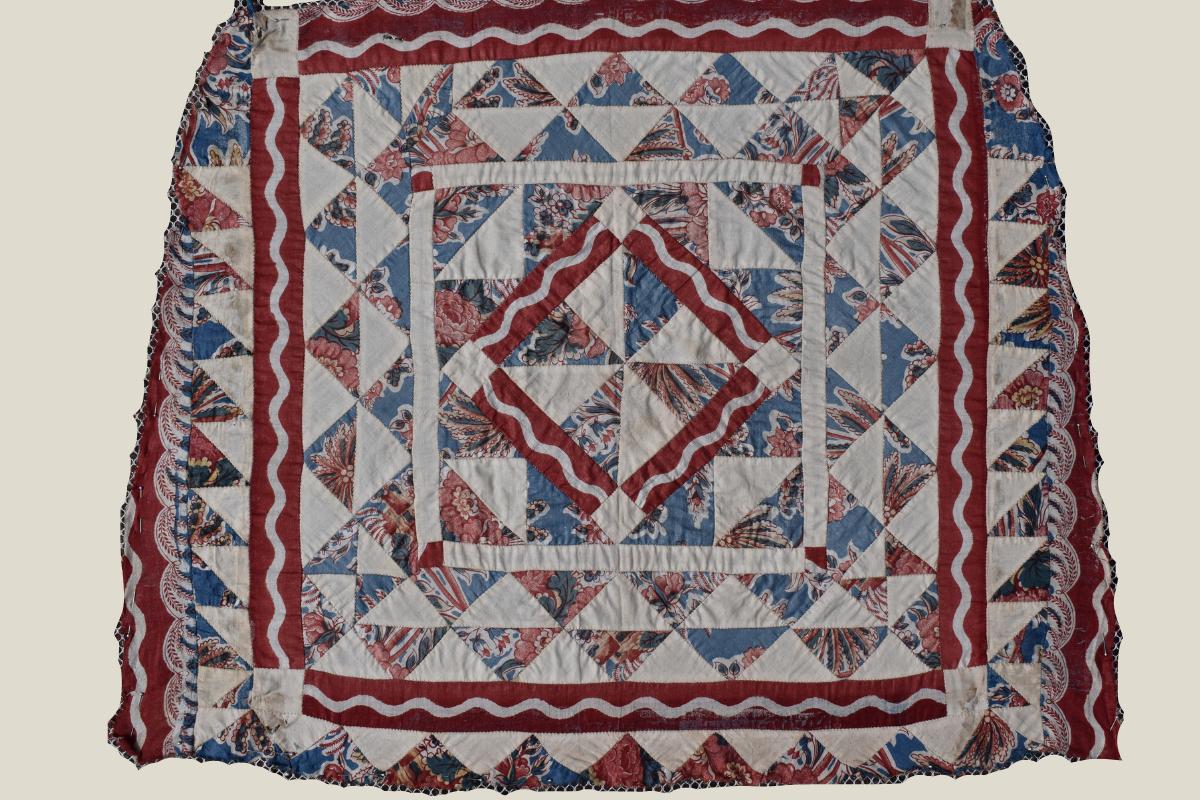
The strange shape of this piece of patchwork can be explained by it's intended use - an upright chair whose seat was wider at the front than the back.
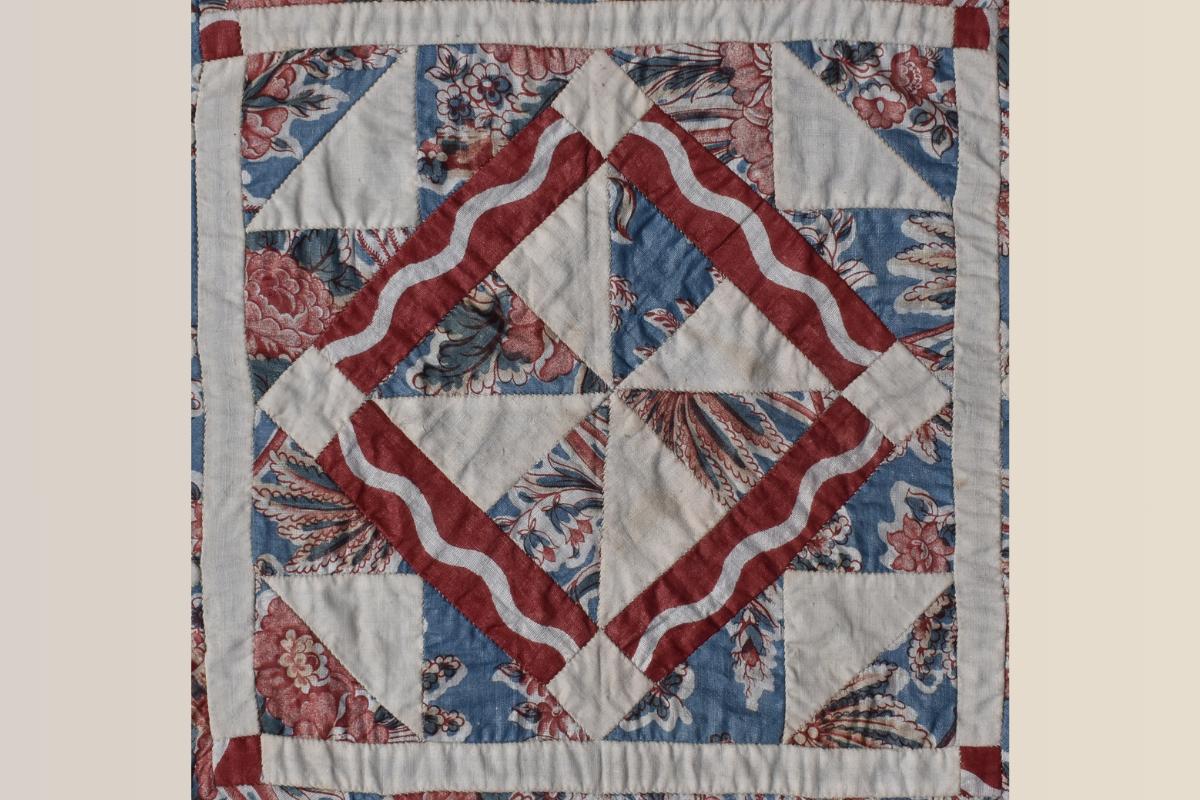
The central Pinwheel is set on point and is surrounded by a red border with plain cornerstones. Triangles are added to the corners to achieve a square format, which is then surrounded by a narrow border of plain calico with red cornerstones.
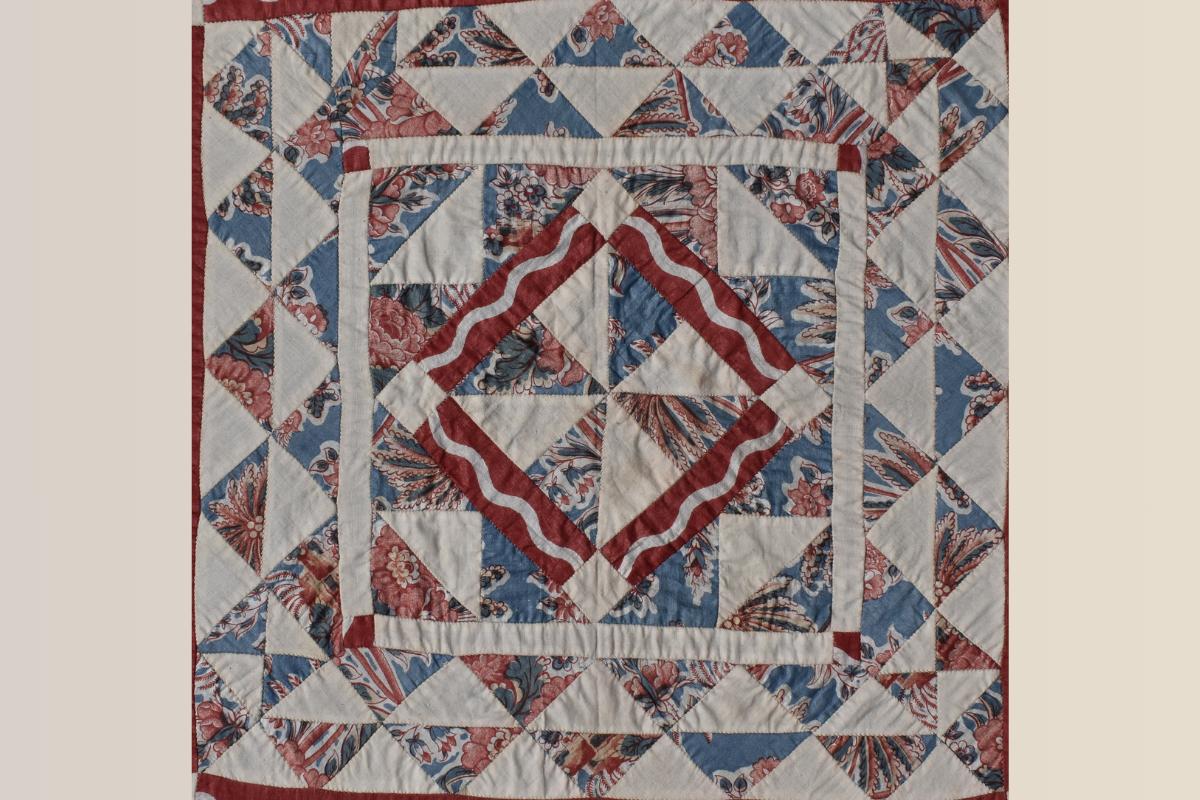
Two rows of triangles make the next border. Although at first glance it looks perfect, the maker has needed to make adjustments during the stitching process to make the triangles fit along the borders.
Note the difficulties with the corners – two are good, one is moderate, and one (probably the last) has caused real problems!
If you count the number of triangles on each side of the outer border, you will also discover that the right hand side has more than the left.
The patchwork was found mounted in a rectangular wooden frame. Unfortunately, it had been stuck in place very firmly with masking tape and glue. Patience and cold water eventually got it off the card mount, but unfortunately much glue remains, and the original glazed finish on the chintz was lost.
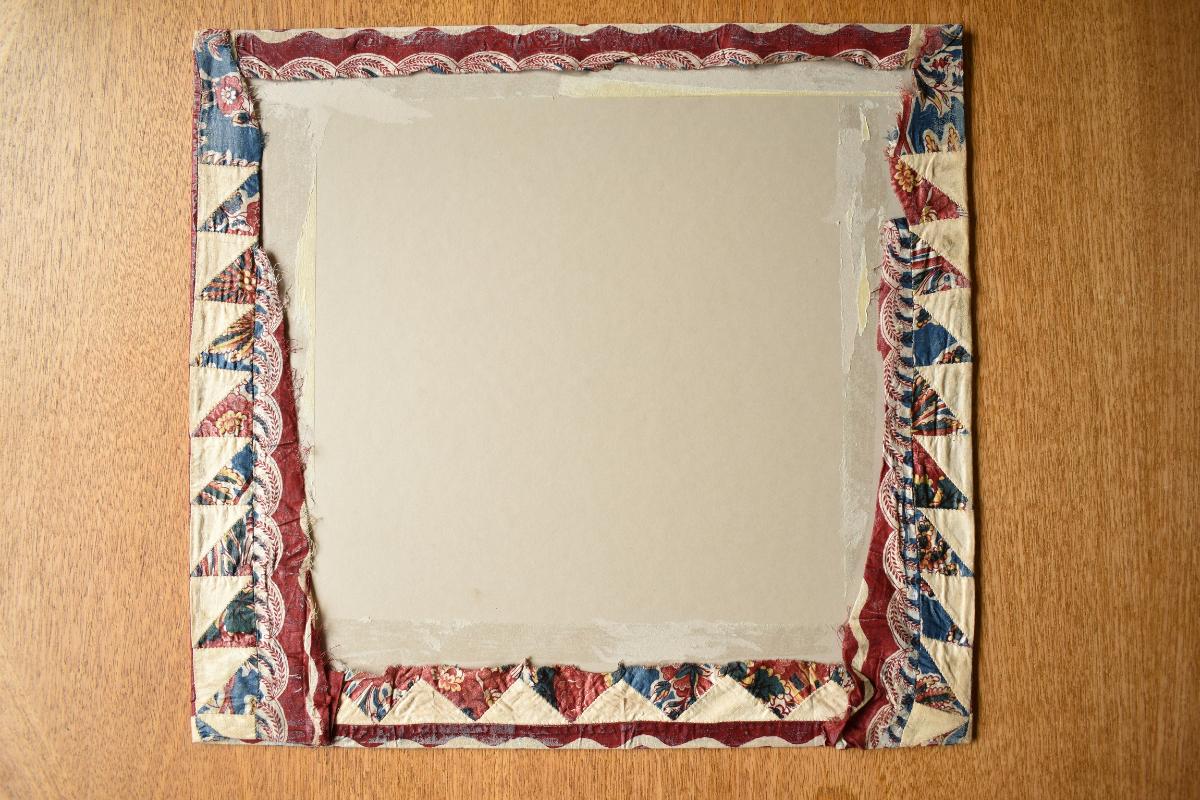
The shaped edges of the patchwork had been turned back over the mounting board and stuck firmly in place.
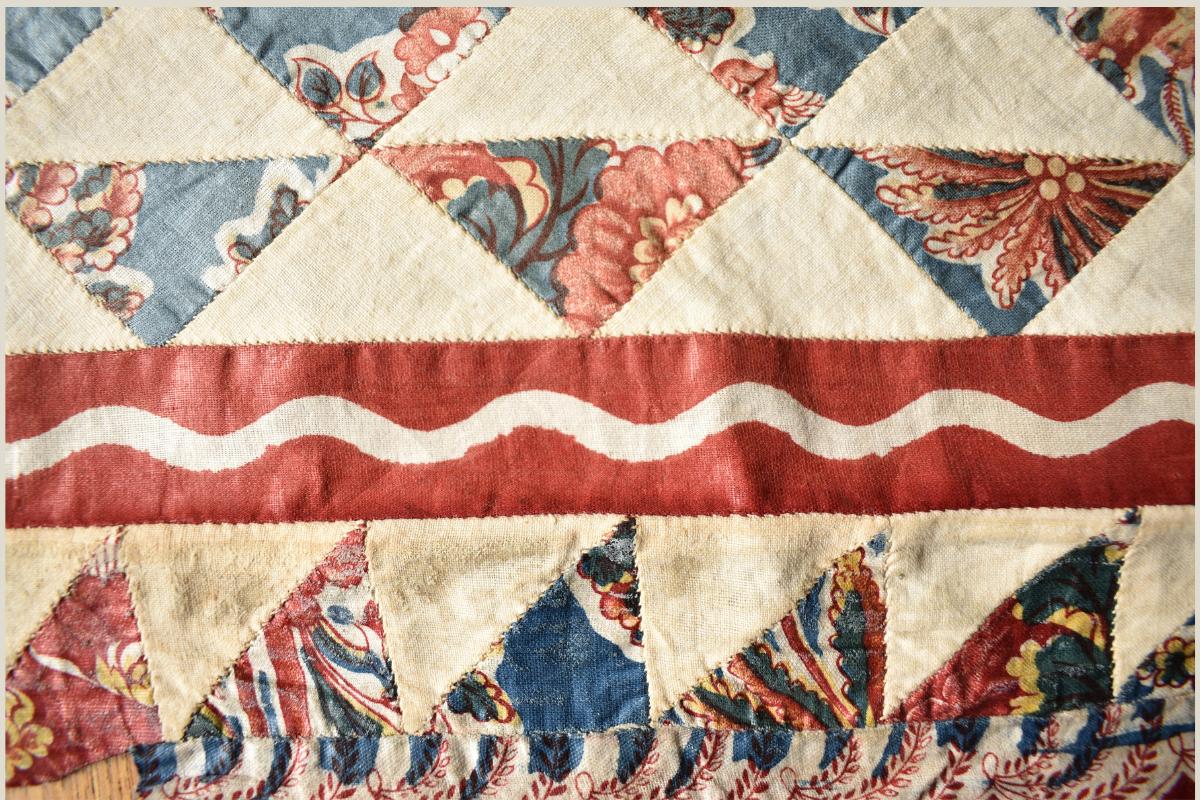
Comparing the faded colour of the central blue chintz triangles to the section which was protected from the light while turned to the back in the frame, the difference in colour can be seen. The original blue, red, yellow and green are much brighter.
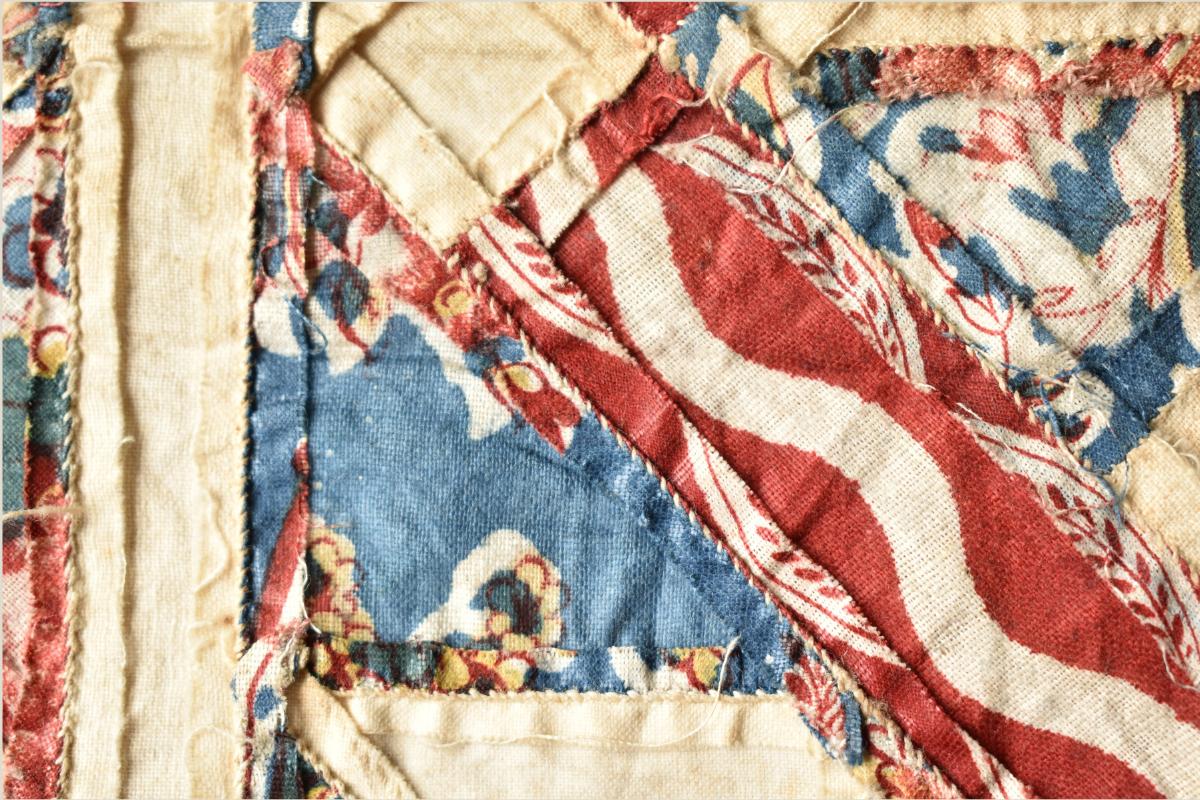
A study of the back shows the oversewing stitches used to assemble all the patchwork, including the long border seams. Although no traces of paper remain, it is likely that the mosaic patchwork technique of piecing over papers was used to achieve the precision.
During the first half of the nineteenth century, natural dyes obtained from plants were used for dyeing. Many of these were fixed by mineral substances called mordants. The printing and dyeing processes were complex so fabric was expensive, particularly if multi-coloured. Slow block-printing was gradually pushed aside by faster techniques printing from engraved copped rollers. Both techniques can be seen on the fabrics in this patchwork.
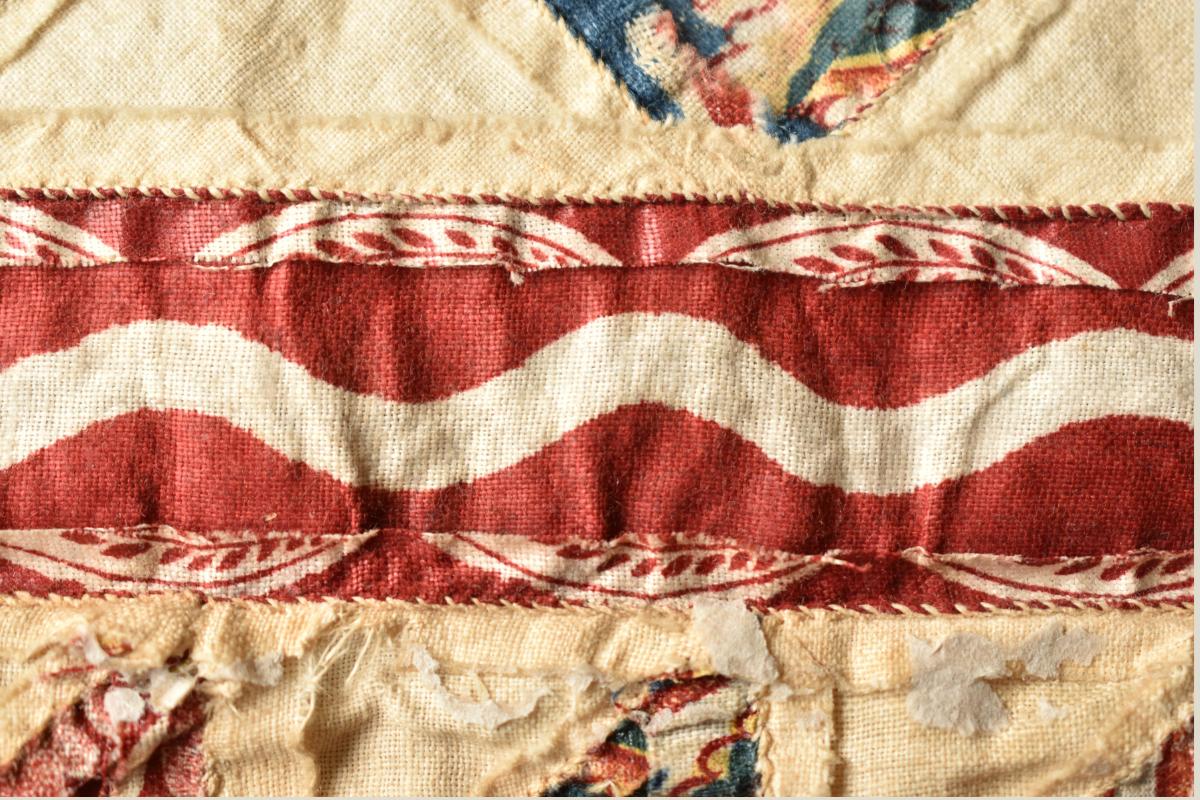
The red colour would have been obtained by dyeing the cotton fabric with madder, using an alum mordant. The fabric used so effectively for the wavy design on the inner borders has actually been cleverly fussy cut from a more complex fabric, as can be seen from the back
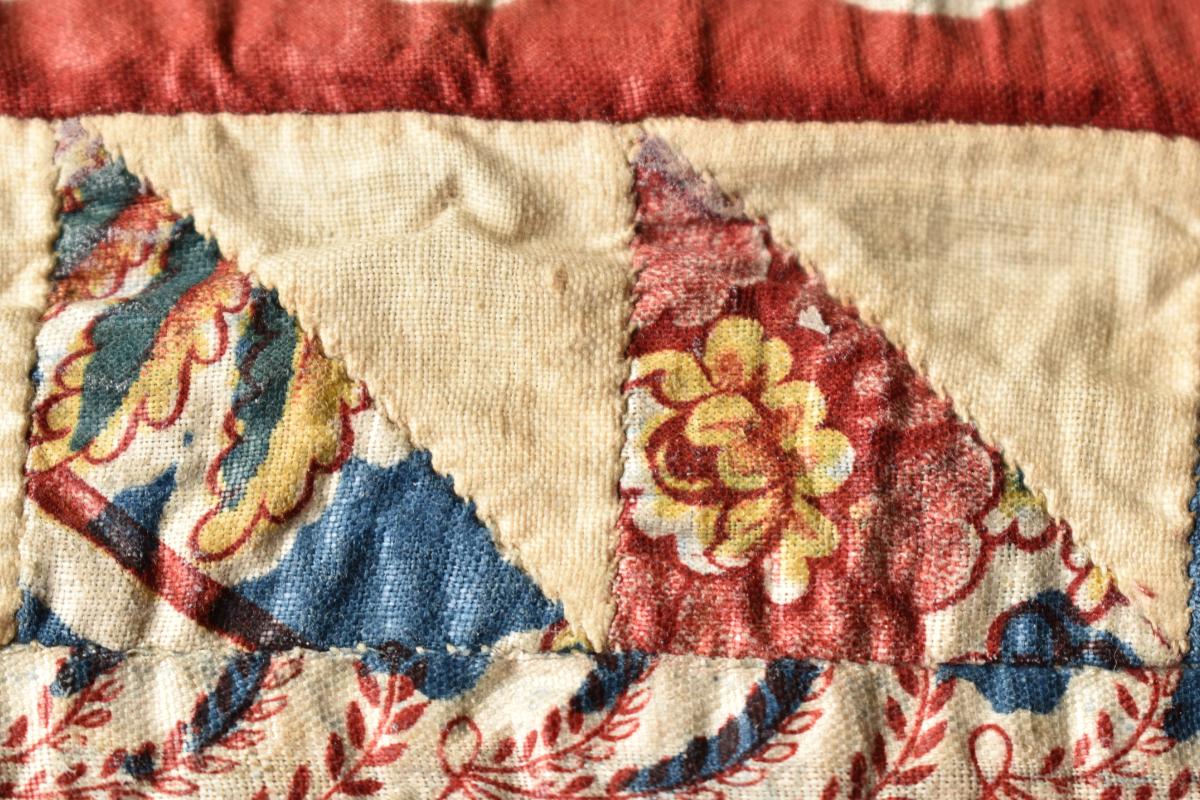
The quality of printing on the blue ground chintz varies considerably – the red is printed very well, but the yellow & blue (often overprinted to give green) are much cruder.
Two shades of red were achieved by stipple engraving on engraved copper cylinder.
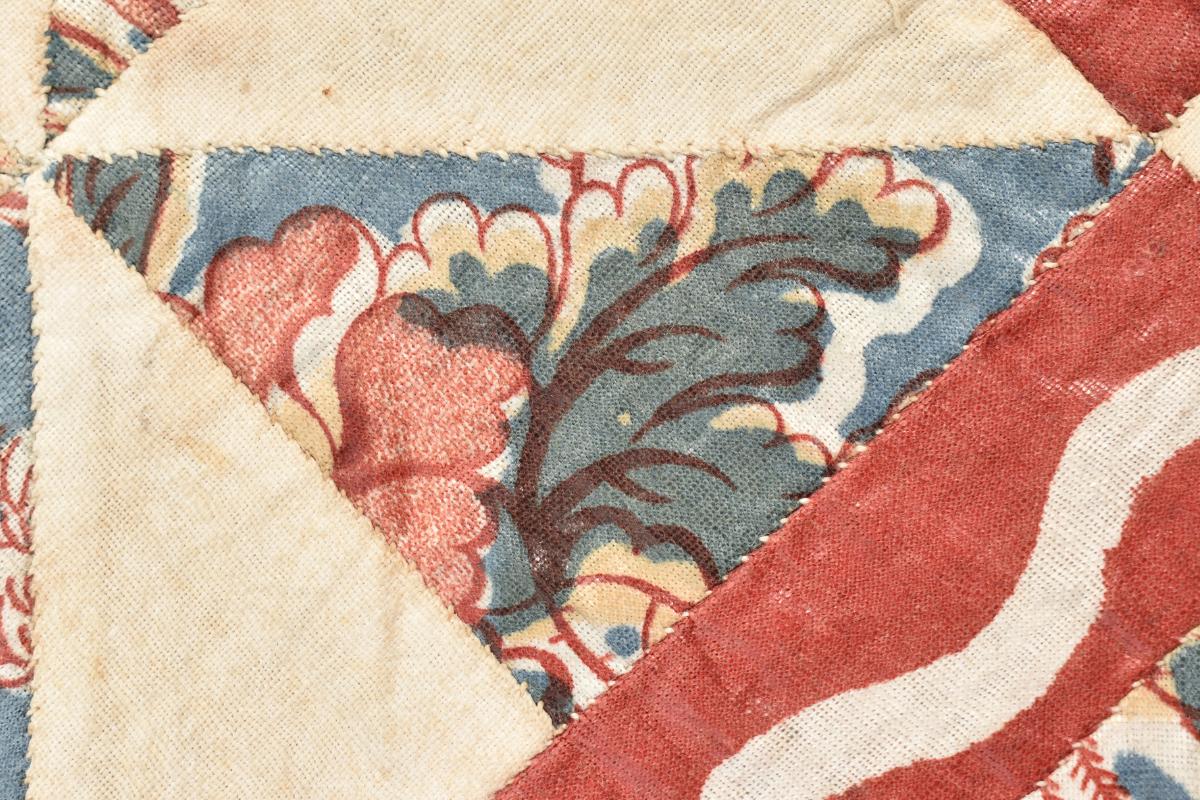
Both yellow and blue appear to be printed (rather than pencilling as at the beginning of the nineteenth century), as some areas are clearly out of alignment by a consistent amount – these should be overlaid exactly to give a green leaf within the red outline, placed centrally within the blue void.
This could have been made using block printing or wooden surface rollers. The blue is probably Prussian Blue, which could be printed on fabric from 1800 onwards. The yellow is likely to be quercitron, which rapidly overtook weld as the yellow of choice at the beginning of the nineteenth century.
Look at these two pieces of fabric from the edge in particular; they tell you something very interesting!
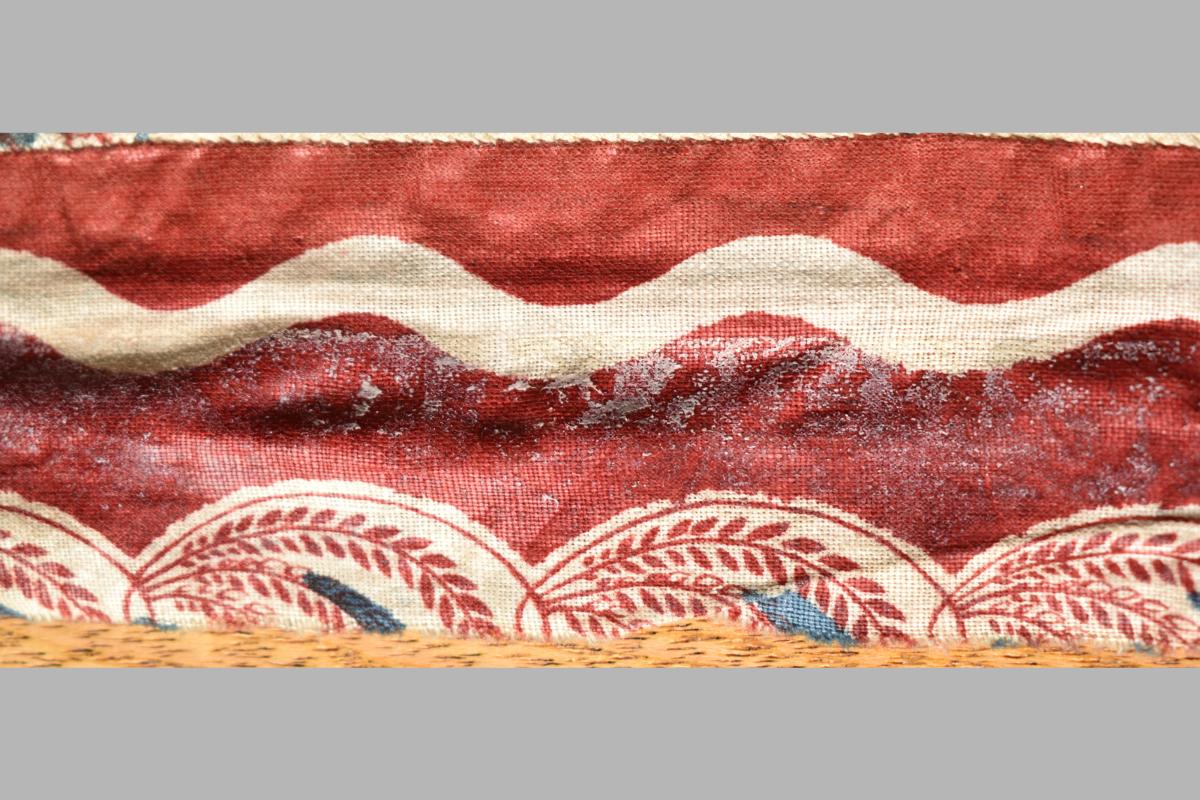
The red fabric is not as simple as just the wavy line. It includes the leafy boughs - and, if you look at the next photo, this continues onto the blue ground sections.
There is in fact, only one printed fabric in this piece of patchwork! The red wavy design is part of the blue ground chintz.
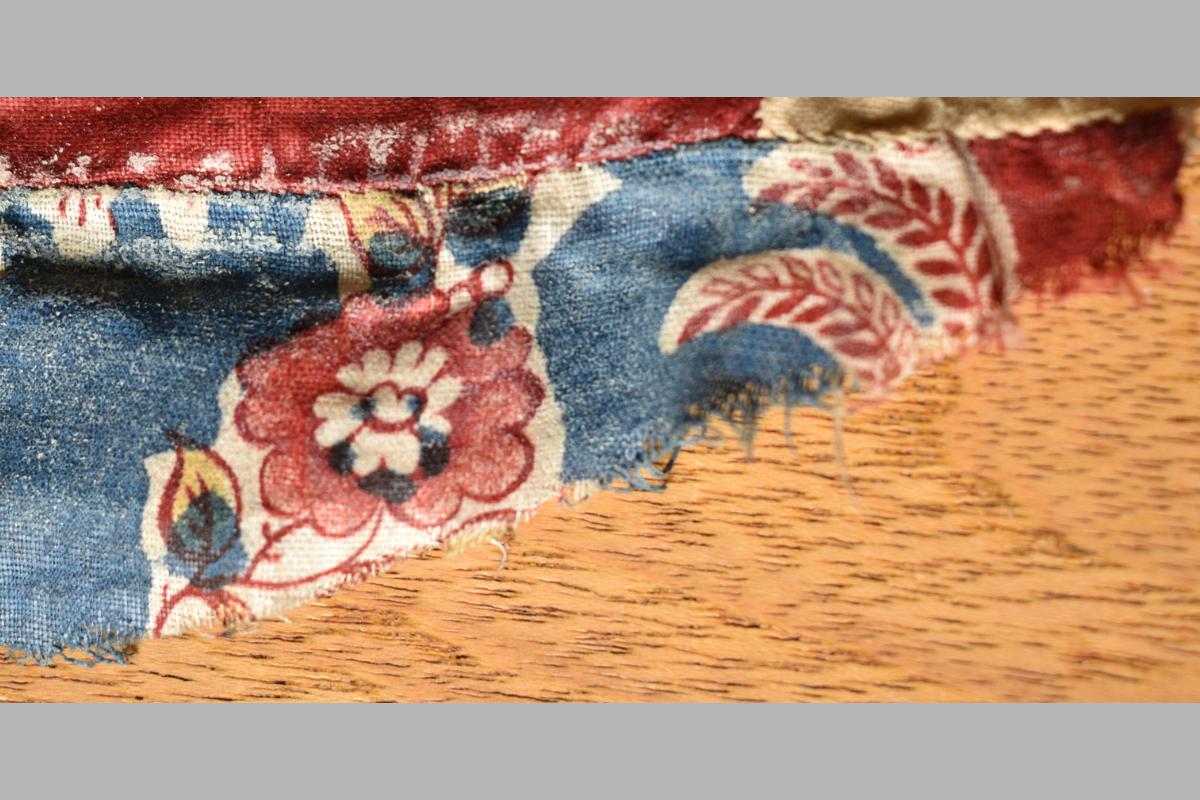
This scrap of fabric was added to increase the width of the chair seat at the front. It reveals how the blue and red sections of the design were printed adjacently.
The better quality of the print for the red compared to the blue and yellow could be explained by a multi-step block & cylinder combination.
Alternatively, a Union machine could have been used. These combined a single engraved copper cylinder with one or more wooden surface rollers, and were developed from 1805 onwards.
Samples of similar blue ground chintzes dated 1820 - 30 (e.g. Winterthur 1969.3560.007 with flowers, leaves and palm trees arranged in broad columns between red wavy lines, in the same style as our fabric) can be found online in the Winterthur Museum Collection
