Unfortunately, we don't support Internet Explorer anymore as it has been replaced by Microsoft Edge.
Please try downloading Microsoft Edge or an alternative modern browser for the best experience.
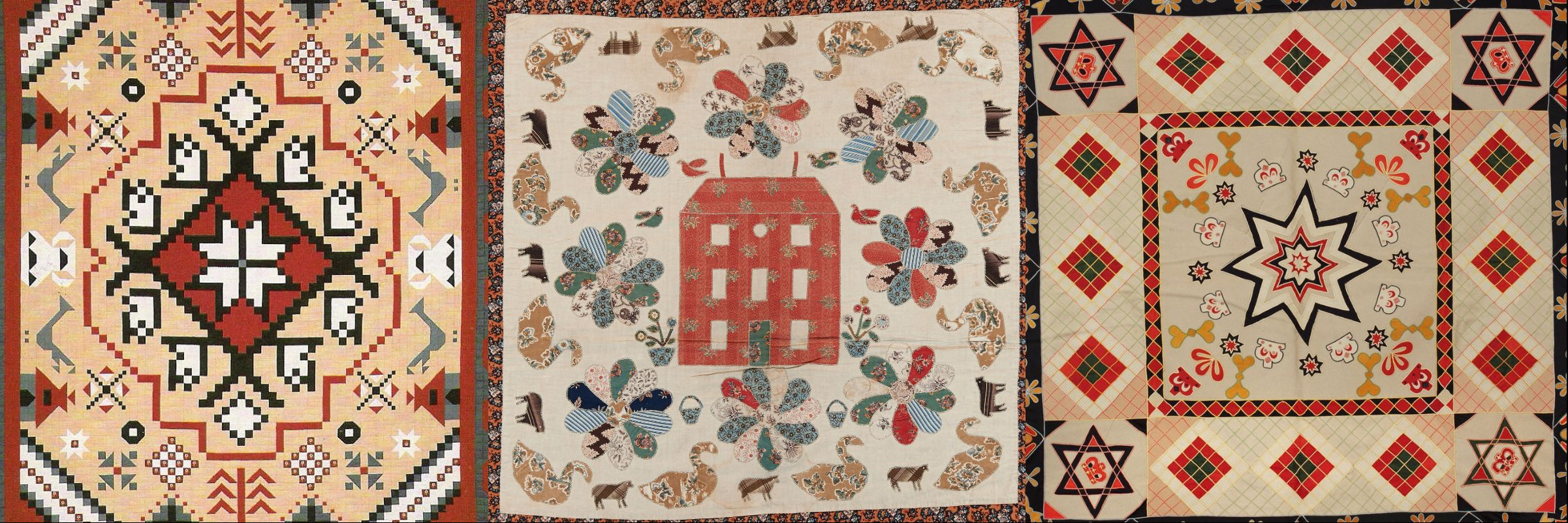
Created in collaboration with Scottish designer DoodleCraft Design, Blackadder Livery, The Red Manor House and Arabian Nights are the first in what we hope will become a growing range inspired by The Collection. Blackadder Livery and Arabian Nights have also been interpreted as tapestry designs, giving stitchers another way to make them their own.
For us, though, this is about more than creating new patterns. It is another way of bringing our Home of Stitched Textiles to life.
Quilting will always sit at the heart of The Quilters’ Guild, but the story of stitched textiles has never fit neatly into one technique.
Patchwork sits alongside appliqué. Embroidery appears on quilts. Tailoring scraps become coverlets. Fabrics created for one purpose find an entirely new life in another.
The Quilt Collection, with more than 900 historic and contemporary pieces, is an extraordinary record of that creativity.
But we don't only want the pieces within it to be admired.
We want them to inspire people to make.
That idea drives our new collaboration with DoodleCraft Design: taking details from pieces in The Collection and translating them into designs that today's stitchers can put in a hoop or frame and recreate for themselves.
And we've begun with three very different textiles.
Full image of Blackadder Livery Coverlet
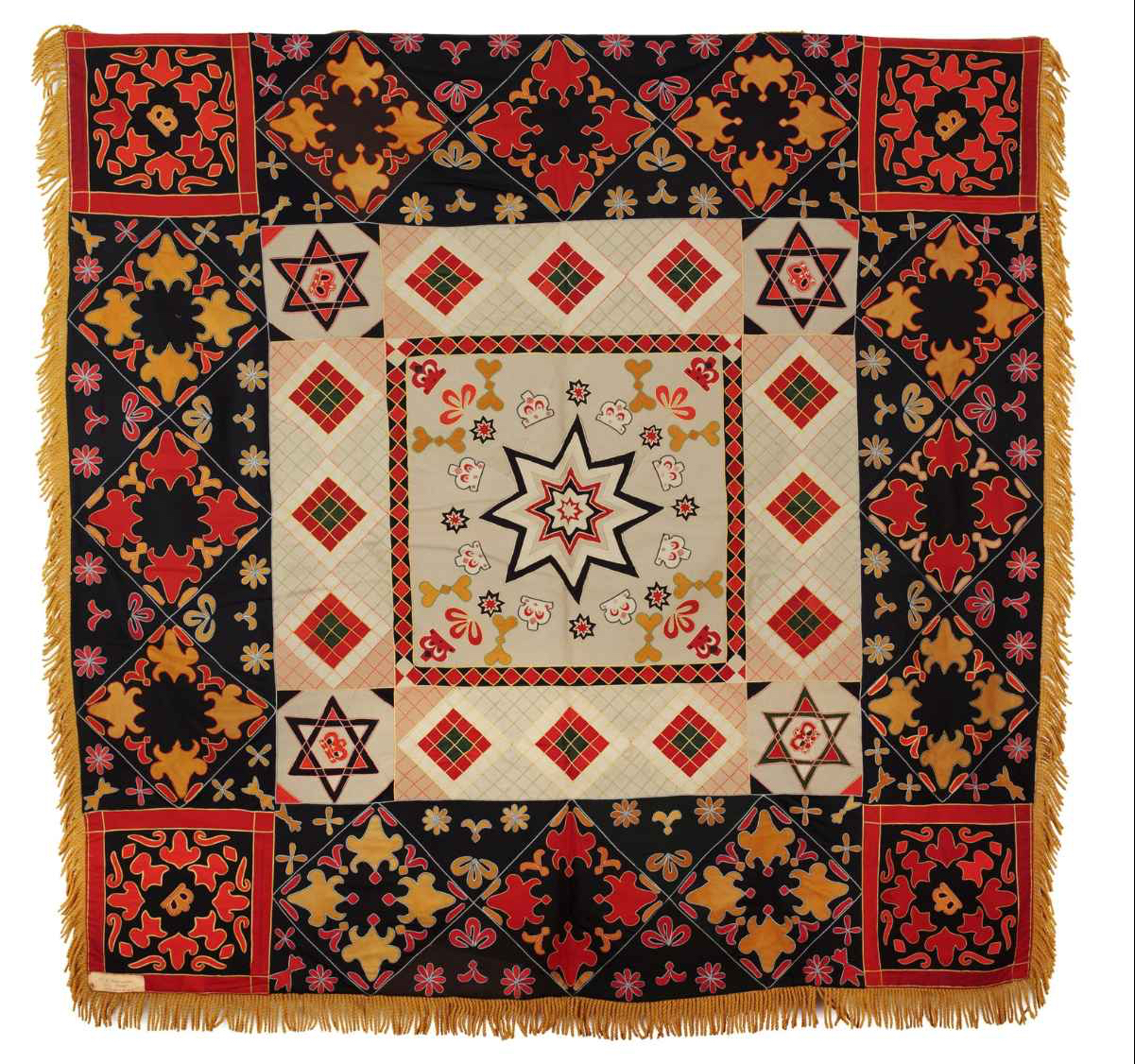
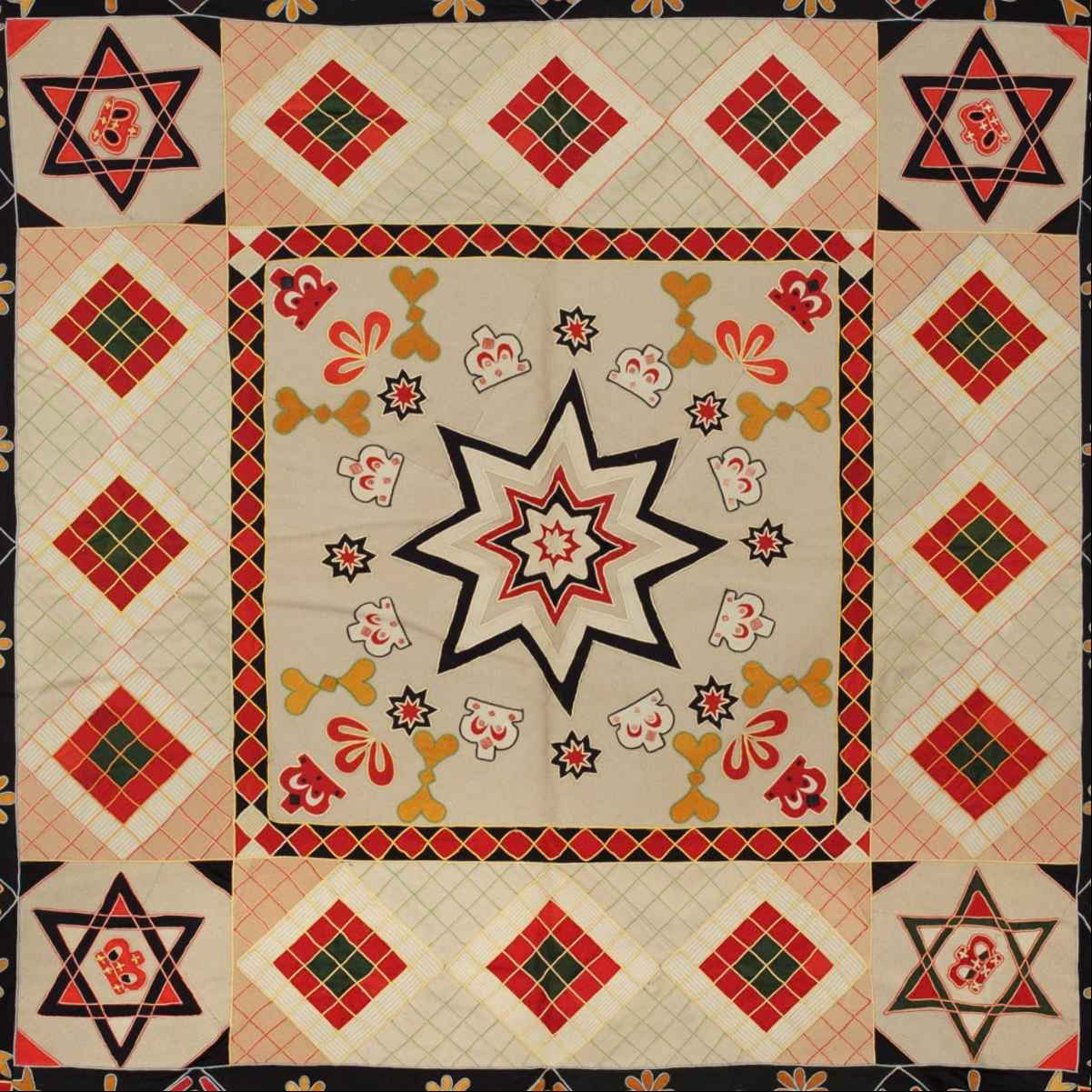
With its strong geometry and striking symmetry, the Blackadder Livery coverlet was the first Collection piece Debbie Harding of DoodleCraft Design chose to translate.
The original wool coverlet was made in the tradition of military or uniform coverlets, using off-cuts of staff livery, the special uniforms worn by servants, from the once-grand Blackadder Estate in Allanton, Berwickshire.
It was made by tailors employed in William Purves' tailoring business in Allanton for his daughter, Jane Melrose Purves, when she married Robert Harrower in 1898, aged 24.
Allanton itself had a reputation for fine tailoring. Despite being a small village, at the beginning of the twentieth century there were 33 tailors working there across three separate businesses. Jane's father owned one of them, and amongst his clients was Blackadder House.
Close-up of Blackadder Livery showing the geometric design
Tailoring was highly skilled work requiring great accuracy. Tailors traditionally stitched cross-legged on raised tables near large windows, making the most of natural daylight while allowing them to handle heavy fabrics.
The off-cuts from that work could easily have disappeared.
Instead, pieces of fabric originally intended for servants' uniforms became part of a coverlet made to celebrate a daughter's marriage. More than a century later, that same coverlet has provided the starting point for yet another kind of stitching.
Its geometry also made it an ideal first project for Debbie.
“I chose the Blackadder Livery as my first piece to translate to cross-stitch, as it is very symmetrical. This helped me learn how the process would work and iron out how I was going to approach the shapes.”
Today, the design can be recreated in either cross-stitch or tapestry.
And once Debbie had worked out how to translate those strong geometric shapes, she was ready to try something rather different.
Red Manor House Coverlet
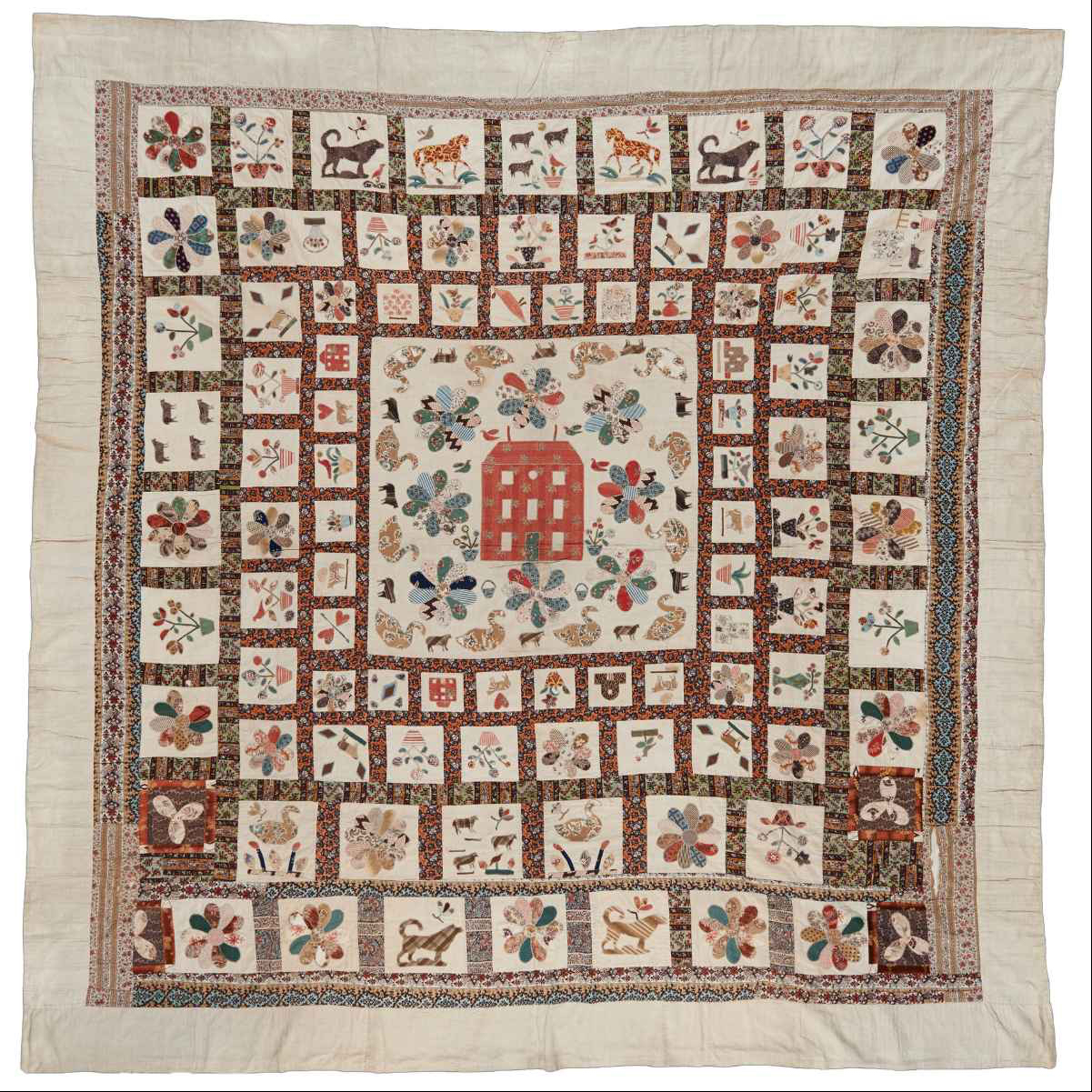
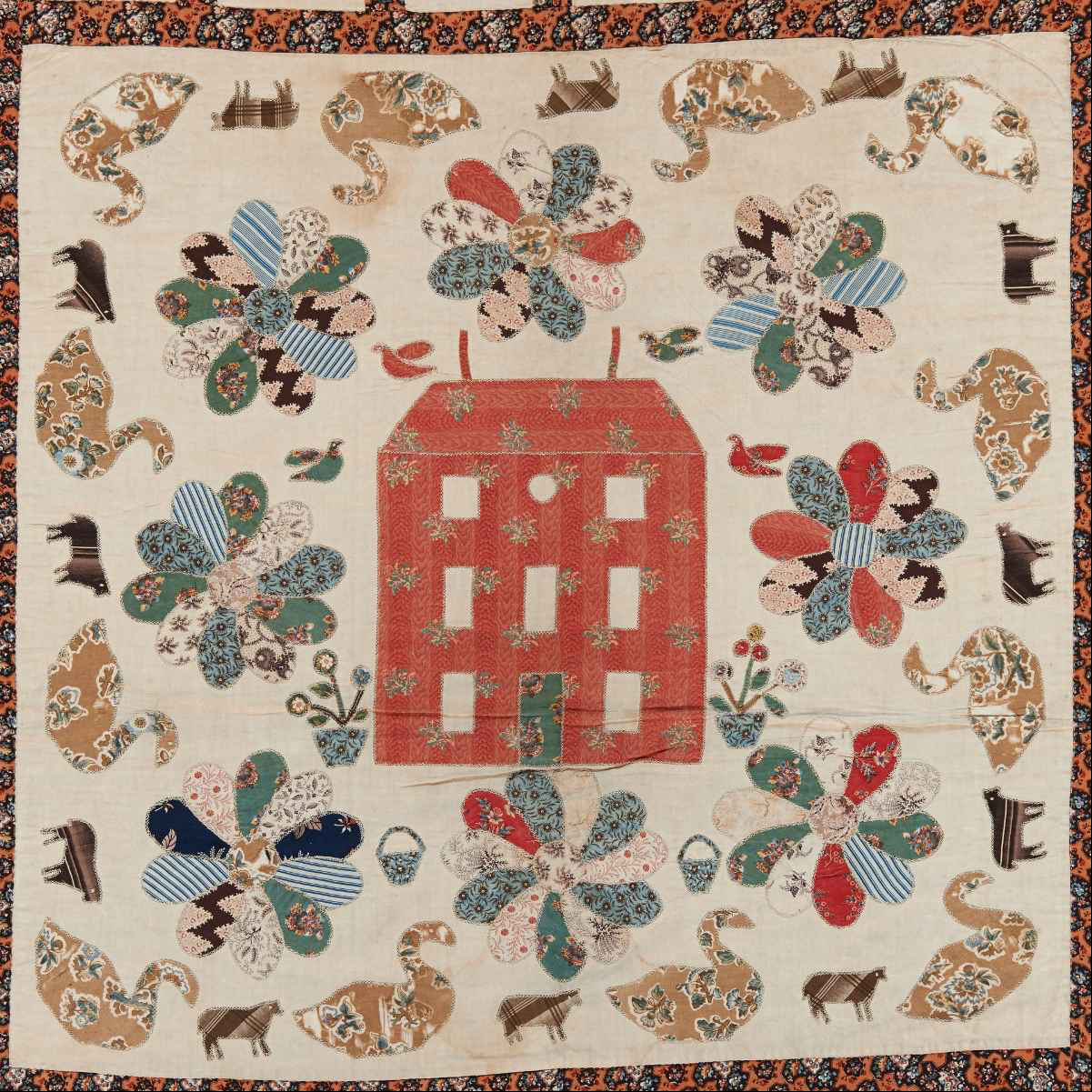
The charming red house sitting at the centre of this large appliqué coverlet has made The Red Manor House a firm favourite with Quilters' Guild members.
When the piece came up for auction in 2013, its extraordinary collection of flowers, animals and other motifs captured imaginations and hearts.
Appliqué can be rarer than patchwork and quilting within surviving historic textiles, and this is an extensive example. Each motif occupies its own square block, surrounded by colourful printed cotton sashing.
Look closely, and the subjects are wonderfully ordinary.
Flowers. Potted plants. Rural animals. A house.
They may simply be a reflection of the things its maker saw around her.
Close up of the Red Manor House Coverlet
Sadly, we know nothing for certain about the woman who made it.
We do know something of the coverlet's later travels. It was purchased in 1971 for £28 and, when it was documented at the London British Quilt Heritage Project Documentation Day in 1993, it was recorded that the family had travelled from Gloucestershire to South Africa, taking the coverlet with them, before later returning to live in Princes Risborough in Buckinghamshire.
As the coverlet had already been made before those travels, we know its design must have been inspired by an earlier home.
The piece also gives us clues about its maker.
She had access to fabrics, time and sewing skills. Although some motifs are more naïve in style than others, they have been carefully considered, and every individual appliquéd piece has herringbone stitch around its edge — a time-consuming detail when repeated across a coverlet of this size.
All those irregular shapes, patterned fabrics and small details are part of what makes The Red Manor House so appealing.
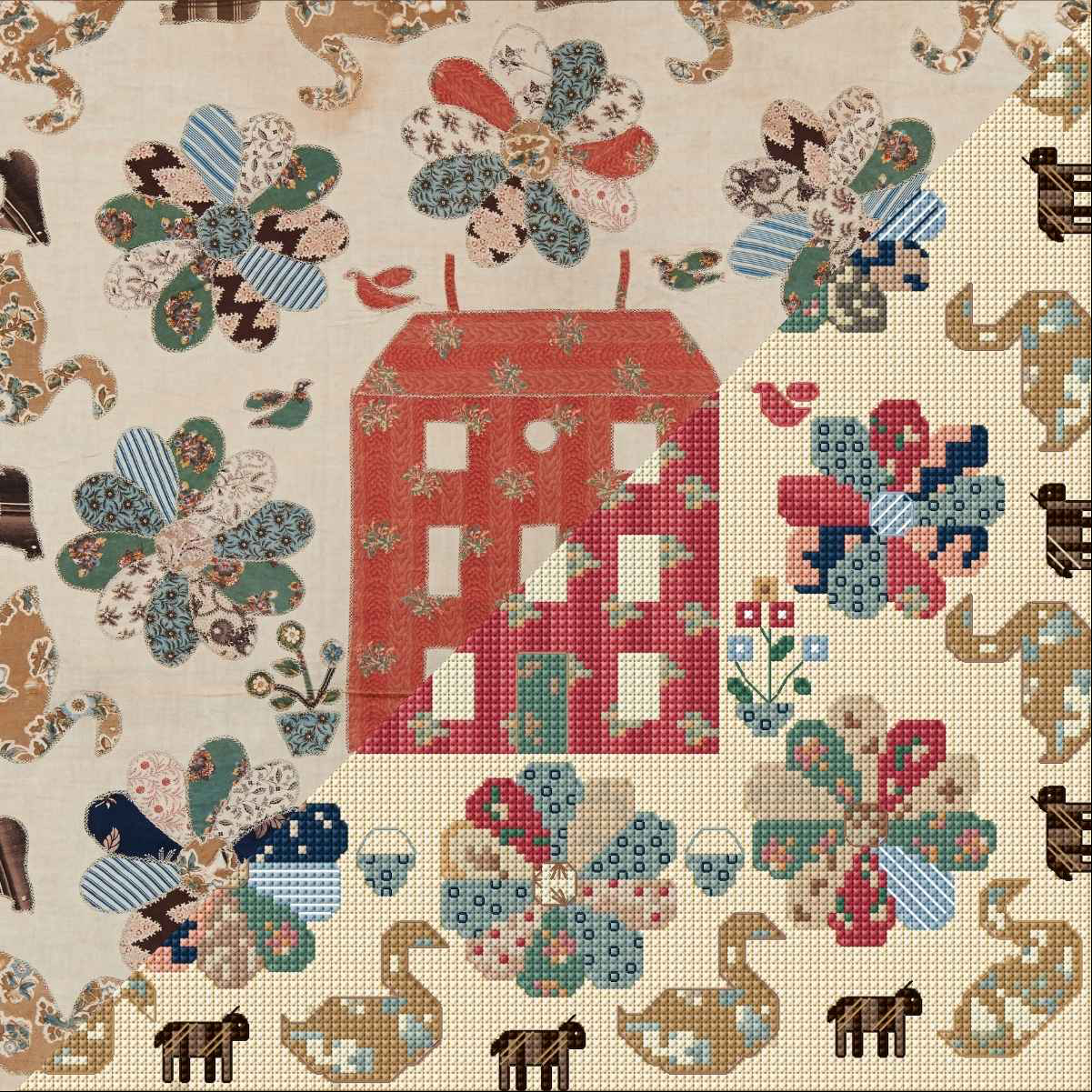
They also made it considerably more challenging to turn into cross-stitch.
“I do like to stay as close as I can to the original piece, but this is harder to do when patterned fabrics and/or intricate shapes have been used as I only have a few stitches to represent the pattern or shape.”
Sometimes a little artistic licence is needed.
Take the cattle. They are small on the original textile and become smaller still when translated into cross stitch. Debbie uses fractional stitches where necessary to help create shapes, while limiting them where she can to keep the design enjoyable to stitch.
And then there were the flowers.
“I enjoyed recreating the flowers on the Red Manor House. These were particularly challenging as there are curved shapes and patterned fabric!”
Close up comparison of the original and cross stitch
Look at the two side by side and you begin to appreciate how much interpretation is involved.
A piece of patterned fabric becomes a handful of coloured stitches. A curve has to work within a grid. A tiny animal still needs to look like an animal.
It isn't simply a miniature reproduction of the original.
It is the same design being spoken in a different stitched language.
Full image of the original Arabian Nights quilt
Our third piece brings the story forward almost a century.
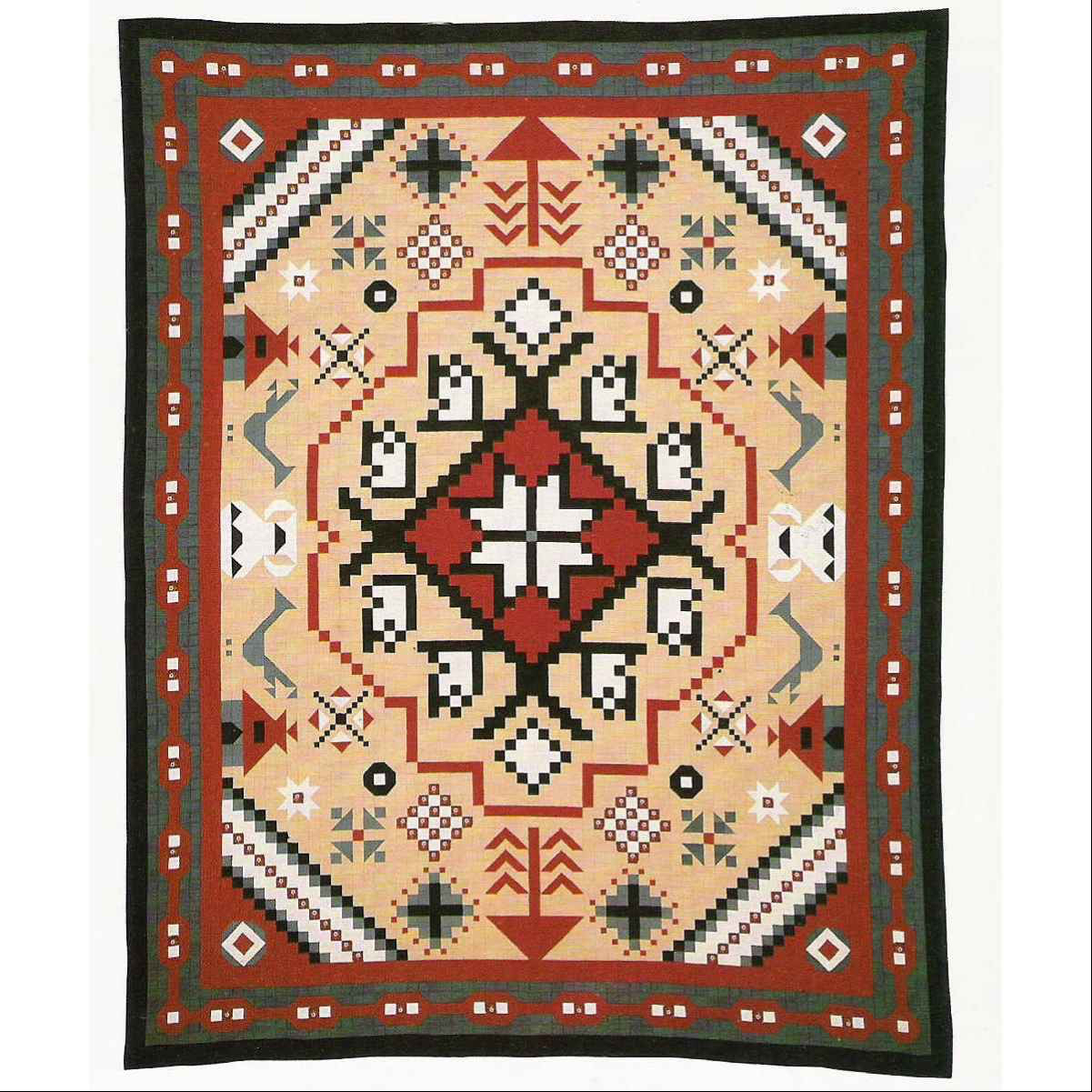
Jane Blenkhorn made Arabian Nights in 1993. It is a squares patchwork quilt, pieced over papers and based on a Persian carpet design. It was created for the Transforming Traditions National Exhibition, held in Edinburgh in 1993.
That gives Arabian Nights a particularly lovely story of creative reinterpretation.
A Persian carpet inspired a patchwork quilt.
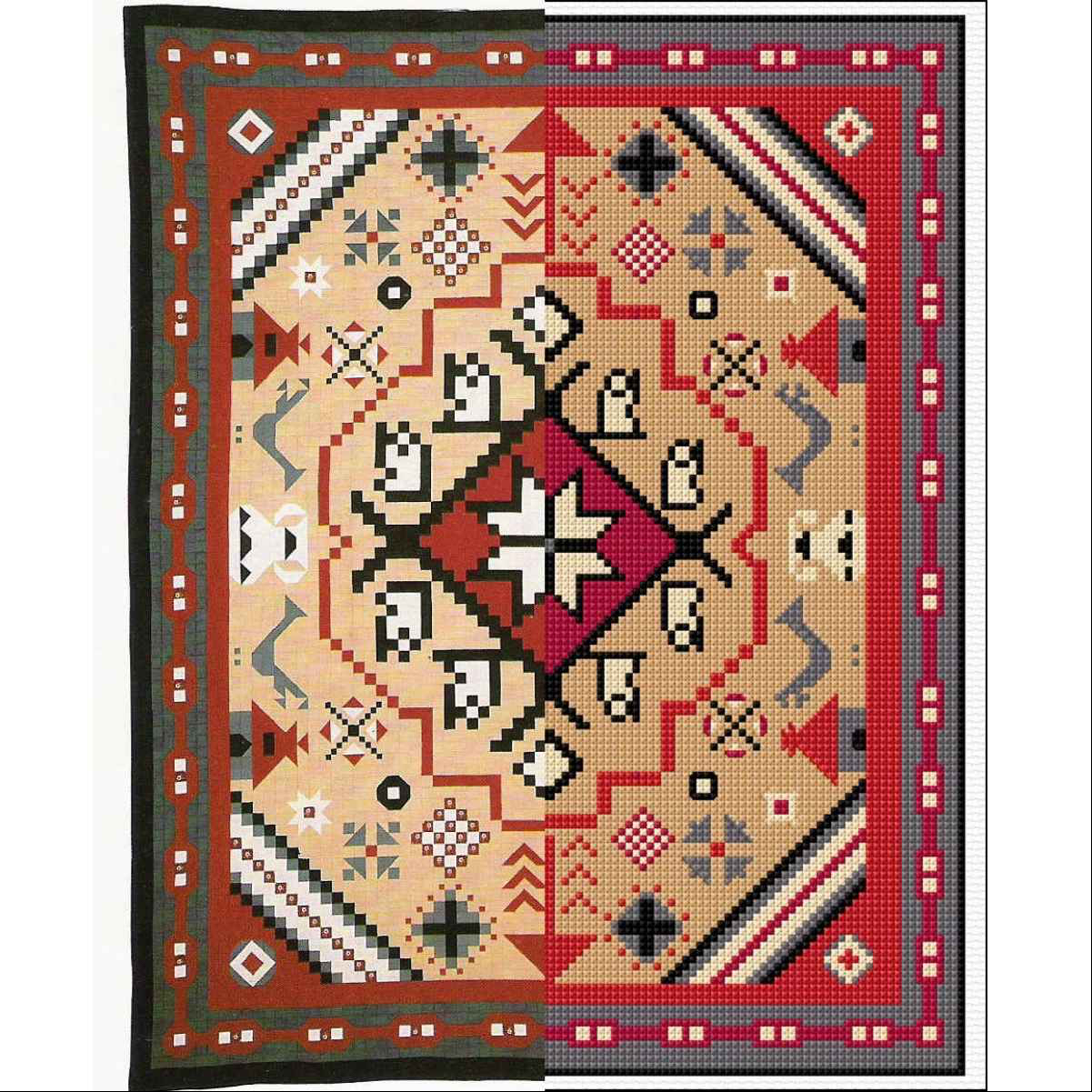
More than 30 years later, that quilt has now inspired both cross-stitch and tapestry.
Arabian Nights original with the finished cross stitch and tapestry interpretations
Each uses a different material and a different method of construction, but the symmetry, repeated motifs and distinctive palette continue from one technique to the next.
The cross-stitch version is worked on 14-count Aida, while its tapestry counterpart uses 14-count mono canvas. Both interpret the design over 124 x 154 stitches to create a finished piece approximately 9 x 11 inches (22 x 27cm).
There is something wonderfully fitting about that journey.
Persian carpet ? patchwork quilt ? cross stitch and tapestry.
One design has moved between techniques, makers and generations while retaining the character that made it interesting in the first place.
For us, that's exactly what the Home of Stitched Textiles should be about.
The process involves more than feeding a photograph into a computer programme.
Debbie begins by spending time looking at the original textile to understand how it was created. She then selects a section, usually around the centre, with enough detail to make it interesting for someone to stitch.
A photograph of that section is imported into specialist software, helping to establish where each element should sit in relation to those around it.
But that's really only the starting point.
The software doesn't provide the detail needed for a finished chart, so Debbie then works by sight, recreating the individual elements and finding the closest colours within the DMC Stranded Cotton or Tapestry Wool ranges.
It's a process that requires decisions at almost every stage.
“Cross stitch and tapestry are very blocky in their make-up so curved shapes are more difficult to get right.”
Printed fabrics have to be reduced to a handful of colours. Curved appliqué shapes have to work on a grid. Tiny details need to remain recognisable.
The aim is to remain faithful to the character of the original without forgetting something equally important:
someone has to enjoy stitching it.
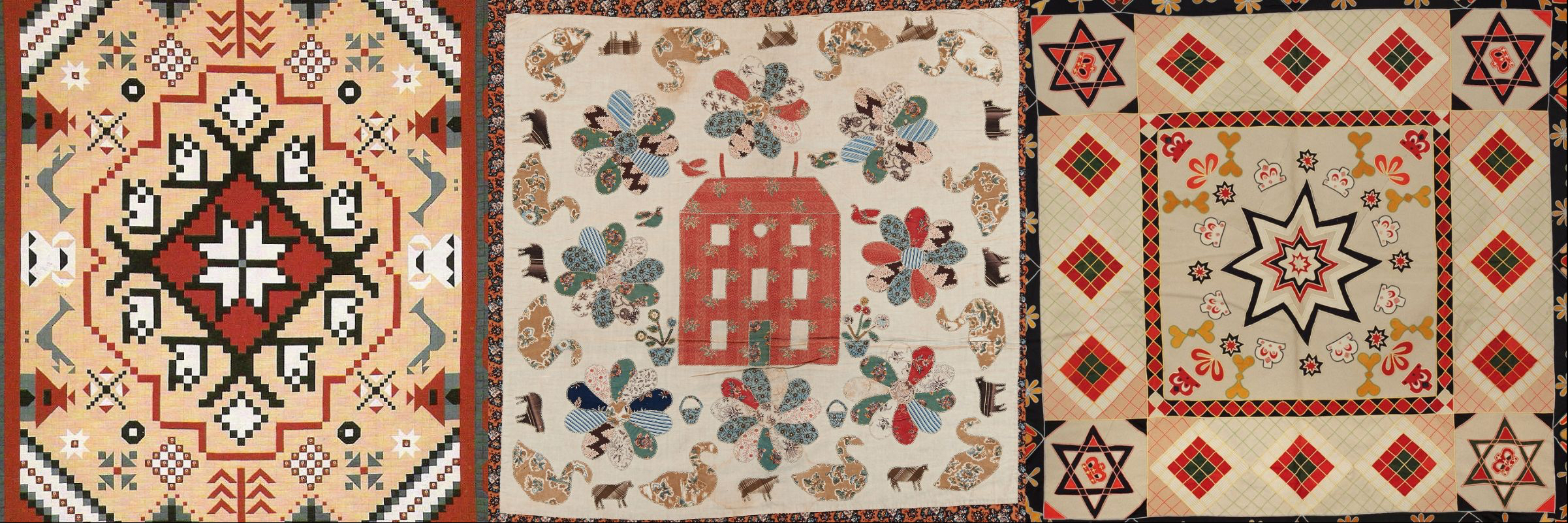
All three finished designs together
There's something rather special about taking a design held within The Quilt Collection and making it again with your own hands.
The originals remain safely cared for as part of the Collection, but their patterns, colours and stories can continue to travel.
The Red Manor House is available as a cross-stitch design, while Blackadder Livery and Arabian Nights can be stitched as either cross-stitch or tapestry, allowing you to choose the technique you most enjoy.
At Quiltworks, you can purchase the chart-only versions, ideal if you already have fabric, canvas and threads at home. And let's face it, quite a few of us have a stash that could do with being put to good use.
If you'd prefer everything gathered together and ready to begin, DoodleCraft Design also offers complete kits.
Whichever option you choose, purchasing from this collaborative range helps support The Quilters' Guild and the continued care of The Quilt Collection.
So while you're creating something new, you're helping us care for something old.
And this is only the beginning: Blackadder Livery, The Red Manor House and Arabian Nights are our first designs.
They won't be the last.
With more than 1000 historic and contemporary pieces cared for by The Quilters' Guild, there is no shortage of colour, pattern, unusual details and extraordinary stories waiting to be explored.
Some may lend themselves beautifully to cross-stitch. Others to tapestry. And perhaps some will inspire us in ways we haven't thought of yet.
Because being the Home of Stitched Textiles isn't only about preserving what has already been made. It's about keeping those skills, ideas and designs moving.
From a nineteenth-century tailor's off-cuts to cross-stitch and tapestry. From an unknown woman's appliquéd flowers to a modern cross-stitch chart. From a Persian carpet to a 1990s patchwork quilt and onwards into the hands of another stitcher.
Different makers. Different generations. Different techniques.
Still making with needle and thread.
Meet quilter and quilt judge Liz Coleman, and discover why hanging sleeves and quilt labels matter ahead of The Quilters' Guild January Online Retreat.
Meet textile designer and quilter Jan Bevan, discover her creative journey and explore Florence, her travelling sewing caddy workshop for Guild members.
Discover textile artist Matt Wilding's extraordinary 3D quilting, from giant quilted sculptures to wearable art, and his creative journey into quilting.
